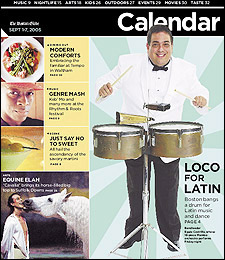





Loco for Latin
The opening of a new downtown nightclub adds yet more heat to Boston's already steamy affair with Latin music and dance
Suzanne Steele was teaching a beginner's salsa dance class at Ryles three years ago when a student accused her of an unlikely transgression. "You do realize this makes you a pusher?'' she recalls him saying, after he confessed that he'd become addicted to salsa dancing after just one lesson.
Steele recounts the story with a knowing laugh, because it's an obsession she understands all too well. She was so smitten with the dance style nine years ago that she founded the weekly salsa dance party at Ryles, which has become Boston's longest running salsa dance night.
These days, though, Steele's salsa party has a lot of company. Boston has has gone loco for all forms of Latin music and dancing, salsa among them. Presenters are bringing Latin events to an increasing number of restaurants and music clubs. Nightclubs better known for their house- and remix-spinning DJ's are adding Latin nights to meet the growing demand. It's now possible to shake a leg (or a hip, or a wrist, or all of the above), Latin-style, seven nights a week. Latin sounds and moves are everywhere, and the trend shows no signs of slowing.
One of the most significant developments in the local Latin scene was the opening last month of Mojitos, a nightclub with plans to offer two floors of Latin dancing five nights a week in its swanky Downtown Crossing digs.
The owners of Mojitos say they hope to fill a void created by the closing last year of Sophia's, the popular Fenway-area salsa destination, according to Jody Mendoza Pekala, a former manager at Sophia's who is now a managing partner of Avive Productions, which runs Mojitos, along with a summertime Sunday night salsa cruise. Pekala says she and her partners heard Latin-dance enthusiasts clamoring for a particular type of dance destination. "An upscale Latin venue,'' she says, " a venue they can go to and hear salsa and merengue and be surrounded by a good looking, well dressed crowd that's out to have a good time.''
Throngs of exuberant dancers are indeed enjoying themselves on a recent Saturday night at Mojitos. People representing a wide range of ages and ethnicities jam both dance floors. The club's basement room boasts a sweaty, sexed-up dance party, as the heavier sounds of merengue and Reggaeton blare amid vivid murals of famous Latin entertainers. In the more elegant upstairs bar, a serious salsa crowd spins and claps and spins some more. Couples show off synchronized dance moves, and groups of friends dance together. Many attendees express eagerness for the club to become a regular entry in their salsa dancing calendars, which include Wednesday nights at An Tua Nua, Thursday nights at Ryles, and Sunday nights at Johnny D's, which features a live band.
"I want to buy stock in this place,'' laughs Nubia Perez, a market analyst whose Colombian heritage has made her a lifelong salsa dancer, as she takes a break from the dance floor on Saturday night. "I don't want it to close.''
The club's owners are trying to ensure Mojitos' success by catering to a wide range of musical tastes and dance predilections. When they expand from the Friday and Saturday night parties now offered to a five night-a-week schedule in mid-September, the offerings will range from the current Saturday night mix of salsa and Reggaeton to Wednesday night's Rock en EspaƱol, featuring contemporary Latin rock music played live.
Mostly, though, Mojitos' managers are counting on the continuing craze for all things Latin to keep their dance floors full. And while many in the Latin dance community insist there were plenty of options after Sophia's closed, most, like Hernan Choque, agree there are enough passionate local dancers and music lovers to support another destination like Mojitos.
Choque should know. When he launched a biweekly salsa e-mail letter two years ago, it was a simple means of keeping about 50 friends and fellow dancers informed about local salsa dance events. Five years later, a staggering 4,500 people receive his e-mails. Choque sees his readers as needing a place like Mojitos, one that offers a broad variety of music and dance styles instead of catering to a single culture or nationality.
"Believe it or not, Boston [has few places] for Latino people to go that aren't Puerto Rican or Dominican,'' he says. "Lately, a couple of them have opened, but before that, if you're from Peru or from Venezuela, and you want to go to a Latin club that has all kinds of music that's Latino, the only place was Sophia's.''
Of course, a lot of fans of Latin dance and music aren't Latino, and the fact that people of all cultures have embraced the craze has contributed to its popularity. For purists who celebrate Latin music traditions, it's a mixed blessing. Alex Alvear, a local musician and performing arts director of La Casa de la Cultura, which hosted a longstanding weekly Latin performance night, says he's saddened to see DJ'd salsa nights eclipse the practice of dancing to a live band. (The nights he hosts now happen only monthly, with the next one featuring Eguie Castrillo's Big Band on Sept. 2.) But he also sees the mainstream popularity of Latin music and dance as a bridge between cultures. "It's helped to sort of break down the barriers and the preconceived ideas about who Latinos are and what our culture is,'' he says.
The cross-cultural pollination shows no sign of abating. An upcoming salsa congress, one of two in Boston -- which is the only city nationally to host more than one such event -- will woo even more devotees. The event, slated for Sept. 16-18, will include workshops, performances, dance nights, a bevy of salsa dance products, and the chance to hit the dance floor with enthusiasts from around the world.
Olaf Bleck, who started salsaboston.com, a popular Web destination for local salsa news and listings, co-founded the upcoming congress after being impressed by one he attended in Washington, D.C., six years ago. "There was just amazing talent,'' he says. "And it was sort of an immersion [in salsa]. I got so much better, just from that experience.''
While the weekend is an apex of local activity, salsa is pretty much always happening in Boston these days. Bleck recalls that when he first started salsa dancing seven years ago, Ryles was the only game in town. Now, though, Bleck can list at least one dance destination for every night of the week, including the Wednesday night parties he hosts at An Tua Nua.
While other dance trends, like swing, have come and gone, Latin dance has endured and grown, which organizers like Bleck and Steele attribute in part to the the inroads Latin American culture and music have made in the US in the past 20 years. And then, of course, there's the infatuation factor.
"The music is just really appealing,'' Bleck says. "And the dance style is very uplifting, and the community that's built itself around this activity is also just wonderful.''
Adds Steele, "And then there are people like me who get addicted to it.''